- Home
- Sponsors
- Forums
- Members ˅
- Resources ˅
- Files
- FAQ ˅
- Jobs
-
Webinars ˅
- Upcoming Food Safety Fridays
- Upcoming Hot Topics from Sponsors
- Recorded Food Safety Fridays
- Recorded Food Safety Essentials
- Recorded Hot Topics from Sponsors
- Food Safety Live 2013
- Food Safety Live 2014
- Food Safety Live 2015
- Food Safety Live 2016
- Food Safety Live 2017
- Food Safety Live 2018
- Food Safety Live 2019
- Food Safety Live 2020
- Food Safety Live 2021
- Training ˅
- Links
- Store ˅
- More

Advertisement
Featured Implementation Packages
-
Small Business Food Safety Management System
The Small Business Food Safety Management System is a great value Food Safety Ma... more
-
SQF Implementation Package for Growing & Fresh Produce - Edition 7.2
The SQF Code Growing and Production of Fresh Produce Implementation Package is a... more
 0
0

Human Error in Food Safety: How Digital Standard Work Reduces Variability in High-Risk Processes?
Dec 06 2025 07:52 PM | Simon
digital standard work human error food safety food manufacturing compliance allergen changeover control sanitation verification CCP monitoring digital SOPs workflow automation food safe audit readiness food industry reducing process variability
Why Human Error Persists in Food Manufacturing?
Human error is a thorn in the flesh of non-conformities and recalls, and although HACCP and GFSI standards are the focus of decades of attention, these standards do not yet mitigate the impact of human error. There are three types of errors:
- Skill-based errors: slips or lapses in routine hygiene practices. Example: forgetting a handwashing step before entering production.
- Rule based errors: wrong understanding of SOPs including use of incorrect cleaning agent during a line changeover.
- Errors based on knowledge: bad decisions in times of crisis, e.g. publishing a lot without full checking.
The variability is particularly hazardous in high risk sectors such as allergen control, sanitation check or CCP. In such instances, being slightly off the mark is disastrously wrong.
The Concept of Digital Standard Work
The Standard Operating Procedures have become digitalized and contain interactive workflows to guarantee that no variability or compliance can occur at all.
The operators have to interact with:
- Visual instructions: Photos or videos of correct procedures.
- Step sequencing: Operators are not allowed to jump over the stages or do them in any sequence.
- Automated logging: Timed records to establish compliance.
- Validation prompts: The ranges, reminders or forced entries do not allow the wrong entries.
- Real-time escalation: Supervisors are notified in case deviations or omission of steps have taken place.
Case Areas Where Digital Standard Work Reduces Variability
Allergen Changeovers
One of the most typical and most expensive in the industry is allergen recalls. Changeovers are very stressful circumstances when time and accuracy collide.
- Common mistake: There is a failure to clean a surface thoroughly, or to check it in a hurry.
- Digital solution: The workflow step-by-step with the obligatory verification of photos prior to the resumption of the line. Without having to rely on trust only, supervisors are informed when evidence is missing.
The performance of cleaning can be extremely different across the shifts. Late or incomplete entries are usually concealed in paper logs.
- Common mistake: Lost swab points, unsteady concentrations of the chemicals, or filling post-shift records.
- Digital solution: Operators are guided by mobile checklists, which are related to the equipment ID. The logo of the swab is registered immediately, and the deviation results in escalation. The results can be viewed live as opposed to the paper record being available to supervisors.
The compliance of HACCP relies upon proper monitoring. However manual data collecting is error prone.
- Common mistake: Temperatures are keyed in wrong or taken out of memory hours after the fact.
- Digital solution: It is impossible to save inputs that are above or below critical limits. Automatization of timestamps avoids backdating, and the IoT integration will directly access data on sensors - less manual work.
Checks are not efficient unless they are regularly conducted. A lack of time frequently causes the check to be missed, or hasty.
- Common mistake: Operators will be forgetting a verification test or do the test in the wrong way.
- Digital solution: In-built reminders to make sure that tests are taken in time. Digital sign-offs must be evidenced and until this is done, production cannot go on.
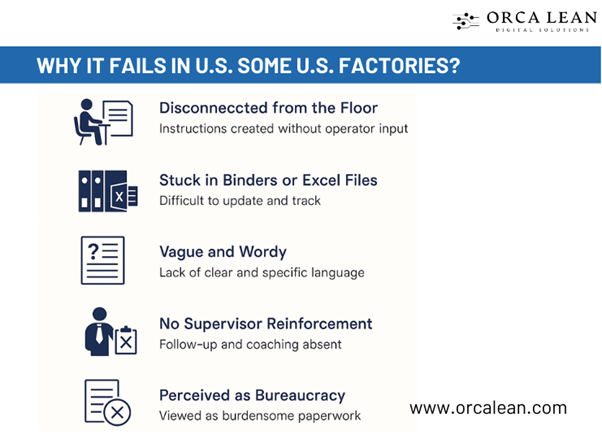
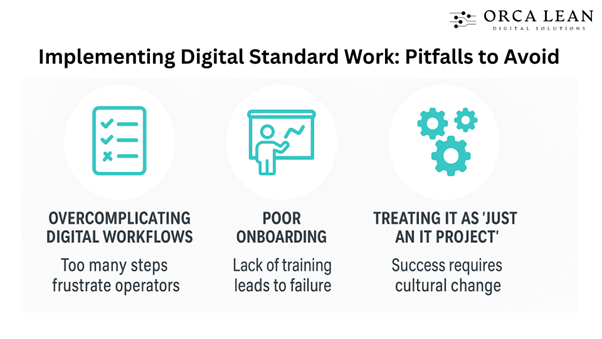
Shifting from paper SOPs to a digital Standard Work system is not simply a matter of uploading documents into an app. To succeed, the transition must be deliberate, phased, and built around the realities of the plant floor.
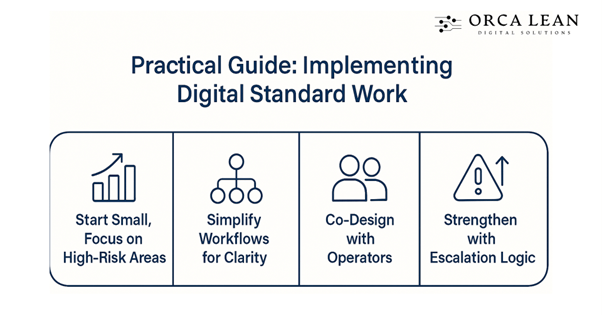
1. Start Small, Focus on High-Risk Areas
Start with those processes which pose the highest risk of food safety or the ones where mistakes tend to happen most frequently. These may be the changeovers of allergens, sanitation checks, or critical control point (CCP) checks. It will help you demonstrate early wins, build confidence, and prove value shortly because you will address high-risk areas first.
2. Simplify Workflows for Clarity
Many SOPs are overloaded with technical detail. Although essential, excessive complexity can make operators too complicated and cause more mistakes. In the process of digitizing, demarcation of workflow into distinct logical processes. Where possible use visuals and ensure the flow is reflected to the real flow of work on the shop floor.
3. Co-Design With Operators
Frontline workers are the ones who live with SOPs every day. Without them, digital workflows are going to be resisted. Engaging operators at an early age will mean that the system is more accurate than conceptual guidelines. This partnership also contributes to the development of buy-in - individuals are in favor of what they contribute to its development.
4. Strengthen With Escalation Logic
The greatest benefit of digitalization is the possibility to add safeguards. Do not merely copy paper checklists- leverage the power of digital to make the system more powerful. Examples include:
- Automated messages in case of check payments.
- Forced ranges of inputs that do not allow out of spec values.
- Step sequencing which will not permit operators to jump ahead.
- Notifications to managers when an anomaly takes place.
Pilot, Measure, and Scale
An effective roll out starts with a pilot test. Select a single line, shift or a department where the digital workflows would be tested. Gather information about the reduction in errors, the frequency of deviations and audit results. Take these lessons to make improvements on the system and then scale them throughout the plant. Un-pilot scaling can lead to resistance or even a duplication of inefficiencies in more than one line.
Food safety incidents are often the result of small human errors — a skipped sanitation step, an inaccurate CCP check, or an incomplete allergen verification. While training helps, it does not eliminate variability in execution.
Digital Standard Work addresses this gap by making compliance structured, auditable, and consistent across every shift. Operators gain confidence, supervisors gain visibility, and auditors gain defensible proof. More importantly, food manufacturers build a culture of reliability where safety is embedded into daily work, not just into audits.
With Standard Work Pro, food companies can digitize SOPs into guided, error-proof workflows that reduce risk and strengthen compliance. It’s the step from meeting requirements to ensuring food safety excellence.


0 Comments