- Home
- Sponsors
- Forums
- Members ˅
- Resources ˅
- Files
- FAQ ˅
- Jobs
-
Webinars ˅
- Upcoming Food Safety Fridays
- Recorded Food Safety Fridays
- Upcoming Hot Topics from Sponsors
- Recorded Hot Topics from Sponsors
- Food Safety Live 2013
- Food Safety Live 2014
- Food Safety Live 2015
- Food Safety Live 2016
- Food Safety Live 2017
- Food Safety Live 2018
- Food Safety Live 2019
- Food Safety Live 2020
- Food Safety Live 2021
- Training ˅
- Links
- Store ˅
- More

Popular products
Product Categories

 Shopping Cart
 All Prices in US Dollars
Customer Product Reviews
-
Annual Premium Membership
Quality elfThis is like my secret weapon, when ever I need to say 'let me check on that and I'll get back to you' you can bet I'm signing......more -
The package was excellent for anyone looking to build a SQF system on their own. The time the package saves you makes it well w......more
-
Lifetime Premium Membership
PepperfireI started following the forums when our food company began implementing FSSC 22000:2005 in 2016. We expect to certify this year......more -
It's early days yet in our program to implement FSSC22000 but so far we're very impressed with the quality of the doumentation......more
-
Practical HACCP Training for Food Safety Teams
Tracey A RichardsonThis was a really good refresher course for me. I am not sure if we need HACCP since we are a farm. It depends on what our cust......more -
Lifetime Premium Membership
helen89Love the community of sharing and learning I have looked up so many things and found answers I need

Practical Internal Auditor Training for Food Operations
Next Live Training:
Friday, May 10, 2:00 PM - 06:00 PM (UK Time Zone). 9:00 AM - 1:00 PM (EST)
Alternatively purchase the previous recording (with 30 day access) to experience the full 4-hour training session along with the presentation slides, templates, end test and certificate of attendance. Make you choice for live or recording during checkout.
This interactive online training webinar will enable participants to develop practical knowledge of the principles of internal auditing enabling them to participate as part of your internal audit team. The webinar provides instruction on how to implement an Internal Audit system and how to prepare, conduct and report on an internal audit.
Instructor: Tony Connor, Chief Technical Advisor, IFSQN
Facilitator: Simon Timperley, Administrator, IFSQN
Cost per attendee: $97.00 USD
Training Course Outline:
Internal auditing is included in Food Safety Management Requirements of the GFSI Guidance Document and as such is a compulsory element of GFSI benchmarked standards including BRC, SQF, IFS and FSSC 22000.
Internal auditing is a tool to verify the effectiveness of the food safety management system, identify and correct non-conformity and demonstrate continuous improvement.
This interactive IFSQN online webinar will enable participants to develop practical knowledge of the principles of internal auditing enabling them to participate as part of your internal audit team.
The webinar provides instruction on how to implement an Internal Audit system and how to prepare, conduct and report on an internal audit.
The course is suitable for all personnel working in food manufacturing, food handling, food storage or food distribution operations.
All attendees receive:
• Copy of the training material (PDF)
• Personalized IFSQN Training Academy Certificate awarded on successful completion of the course and end test
• 30 day access to the webinar recording
The course is delivered in 8 sections:
1. Introduction to Internal Auditing
2. Auditing Documentation
3. Audit Scheduling and Risk Assessment
4. Internal Audit Procedure including preparation, reporting and practical audit examples
5. Guidelines for Auditing Management Systems based on ISO 19011
6. GFSI and GFSI Benchmarked Standards Internal Audit Requirements
7. Internal Audit Exercise
8. Online test consisting of 30 multiple choice questions covering the topics taught in the course.
List of topics covered:
• Introduction to Internal Auditing
• Auditing Document Control
• Auditing Record Control
• The Role of the Internal Auditor
• Setting up an Internal Audit Programme
• Audit Risk Assessment
• Internal Auditor Attributes
• How to create an Audit Checklist
• Categorizing Non-conformities
• Audit Preparation
• Typical Internal Audit Procedure
• Internal Audit Reporting
• Sample Internal Audit Reports
• Sample Non-conformance Reports
• Guidelines for Auditing Management Systems based on ISO 19011
• Purpose of Internal Audits
• GFSI and GFSI Benchmarked Standards Internal Audit Requirements
• Internal Audit Examples
• Good Manufacturing Practice Audit Example
• Sample Audit Plans
• Sample Internal Audit Risk Assessments
• Internal Auditor Tips
• Internal Auditor Do’s and Don’ts
• Sample Audit Checklists
• Practical Exercises – Internal Audit Scenarios

Lifetime Premium Membership
Upgrade your IFSQN membership and gain instant access to the exclusive areas and premium features of the website.
Membership upgrades can be purchased as a 3-month, annual or lifetime option and will enable you to:
- Access the Files Library
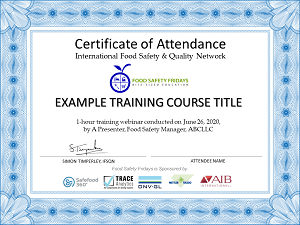
- Download the Presentation Slides and obtain a Certificate of Attendance for all Food Safety Fridays webinars
- Contact other members via the personal messaging system
- Edit your profile
- Edit your signature, including business information, contact details and link to your website
- Display the IFSQN Contributor Rosette in your forum profile

Practical HACCP Training for Food Safety Teams
Next Live Training:
Tuesday, April 30, 2:00 PM - 06:00 PM (UK Time Zone). 9:00 AM - 1:00 PM (EST)
Alternatively purchase the previous recording (with 30 day access) to experience the full 4-hour training session along with the presentation slides, templates, end test and certificate of attendance. Make you choice for live or recording during checkout.
The Practical HACCP for Food Safety Teams Training webinar is suitable for training your food safety (HACCP) team members in Good Hygienic Practices and HACCP implementation as per the requirements of GFSI benchmarked standards including the SQF Food Safety Code and BRCGS Global Standards for Food Safety.
This 4-hour interactive IFSQN online webinar will enable participants to develop practical knowledge of the principles of food safety and HACCP systems also including guidance on Good Hygiene Practices and Application of the HACCP System as per CODEX Recommended International Code of Practice General Principles of Food Hygiene 2022 including a new Decision Tree and HACCP Worksheet.
Instructor: Tony Connor, Chief Technical Advisor, IFSQN
Facilitator: Simon Timperley, Administrator, IFSQN
Cost per attendee: $97.00 USD
Training Course Outline:
At the IFSQN we pride ourselves on providing practical training rather than theoretical. We are pleased to announce an online webinar that you can attend and use to train your food safety team in HACCP implementation and GMP best practices. This interactive IFSQN online webinar will enable participants to develop practical knowledge of the principles of food safety and HACCP systems.
The webinar provides instruction on how to implement a HACCP system from preliminary steps to documenting a Food Safety Plan with CCPs and Preventive Controls. Due to popular demand a section on How the FSMA affects HACCP - Hazard Identification, Evaluation and Preventive Controls is now included.
The course is suitable for food handlers, supervisors, managers and HACCP team members working in food manufacturing, food packaging, food handling, food storage or food distribution operations.
All attendees receive:
• Copy of the training material (PDF)
• Personalized IFSQN Training Academy Certificate awarded on successful completion of the course and end test
• 30 day access to the webinar recording
The course is delivered in 7 sections:
1. Introduction to HACCP
2. Types of Contamination
3. Definitions
4. Good Hygienic Practices/Good Manufacturing Practices
5. HACCP Principles and Developing a HACCP/Food Safety Plan
6. How the FSMA affects HACCP - Hazard Identification, Evaluation and Preventive Controls
7. Online test consisting of 30 multiple choice questions covering the topics taught in the course.
There are interactive exercises to do at the end of each stage including identifying sources of contamination, corresponding control measures to prevent contamination and hazard/control measure assessment.
List of topics covered:
• Introduction to HACCP
• Why Food Safety is important
• CODEX General Principles of Food Hygiene
• Types of contamination
• Where contamination comes from
• Types of Hazard
• Biological Hazards
• Common food poisoning bacteria
• Chemical Hazards
• Physical Hazards
• HACCP Terms and Definitions
• The HACCP team
• Product Description
• Intended Use
• Consumers
• HACCP Scope
• Process Flow Diagram
• Flow Diagram Verification
• Prerequisite Programs
• Conducting a hazard analysis
• Hazard Assessment
• Identifying the Critical Control Points
• HACCP Decision Tree
• Establishing Critical Limits
• Preventive Controls
• Validation
• Establishing a Monitoring System
• Establishing Corrective Actions
• Establishing HACCP Documentation
• Verification

Annual Premium Membership
Upgrade your IFSQN membership and gain instant access to the exclusive areas and premium features of the website.
Membership upgrades can be purchased as a 3-month, annual or lifetime option and will enable you to:
- Access the Files Library
- Download the Presentation Slides and obtain a Certificate of Attendance for all Food Safety Fridays webinars
- Contact other members via the personal messaging system
- Edit your profile
- Edit your signature, including business information, contact details and link to your website
- Display the IFSQN Contributor Rosette in your forum profile

3 Month Premium Membership
Upgrade your IFSQN membership and gain instant access to the exclusive areas and premium features of the website.
Membership upgrades can be purchased as a 3-month, annual or lifetime option and will enable you to:
- Access the Files Library
- Download the Presentation Slides and obtain a Certificate of Attendance for all Food Safety Fridays webinars
- Contact other members via the personal messaging system
- Edit your profile
- Edit your signature, including business information, contact details and link to your website
- Display the IFSQN Contributor Rosette in your forum profile

Practical Supplier Auditor Training
Next Live Training: None scheduled
Alternatively purchase the previous training recording (with 30 day access) to experience the full 4-hour training session along with the presentation slides, templates, and certificate of attendance. Make you choice for live or recording during checkout.
Instructor: Vladimir Surčinski, Auditor and Trainer
Facilitator: Simon Timperley, Administrator, IFSQN
Cost per attendee: $97.00 USD
Training Course Outline:
The Practical Supplier Auditor Online 4-hour training webinar is suitable for those wishing to conduct audits of suppliers either to evaluate a new supplier’s ability to meet your contractual/food safety & quality requirements or to re-evaluate an existing supplier’s performance.
At the IFSQN we pride ourselves on providing practical training rather than theoretical. We are pleased to announce an online training webinar that will show you the main steps in the process of supplier evaluation and audit through clear and simple examples.
In the first part of the training participants will receive instruction on the implementation of different models for effective supplier evaluation; including evaluation of service providers with complete categorization of all suppliers.
Models and processes of supplier evaluation are compatible with the requirements of the GFSI certification schemes such as IFS, BRC, SQF, FSSC 22000 and ISO 22000, which will help you implement them in your company easily.
In the second part of the training participants will receive instruction on developing an audit program, auditors, audit checklists and an audit plan. All this will include practical examples and the possibility to get an insight from the lead auditor perspective.
All attendees receive:
- Copy of the training materials (Slides and Templates)
- Personalized IFSQN Training Academy Certificate
- 30 day access to the webinar recording
- Exclusive post webinar contact with the presenter for further explanation and input
- Introduction to GFSI food standards demands (general and specific)
- Types of suppliers and supply chain demands
- Models of supplier evaluation – practical tools
- Supplier evaluation for deferent types of industries in the food chain
- Defining criteria for evaluation of suppliers
- Evaluation process for suppliers of raw materials (primary production)
- Evaluation process for suppliers of raw materials (food production)
- Evaluation process for suppliers of packaging materials
- Evaluation process for suppliers of services
- Management of results after evaluation
- Categorization of suppliers according to results – definition of list of suppliers
- Definition of action plans for supply chain emergencies
- Communication of evaluation results and defining of specific food safety goals
- Models of audits (first party, second party, third party audit)
- Supplier audits – general requirements
- Announced audits
- Unannounced audits
- Development of the audit program
- Supplier audit – primary production
- Supplier audit – food production
- Supplier audit – packaging materials
- Supplier audit - services
- Training and selection of auditors (internal / external)
- Development of audit checklists
- Development of the audit plan and communication with the supplier
- Performing the supplier audit
- Methods of auditing
- Auditor behaviour
- Collection of useful data during the audit
- Recording of data and corrective action plans
- Type of reports and communication of audit results
- Management of audit results and definition of specific food safety goals

Practical Food Defense (TACCP) and Food Fraud (VACCP) Training
Next Live Training: None scheduled
Alternatively purchase the previous recording (with 30 day access) to experience the full 4-hour training session along with the presentation slides, templates, end test and certificate of attendance. Make you choice for live or recording during checkout.
This interactive IFSQN 4-hour online training webinar will enable your food safety team to develop practical knowledge on how to implement a fully developed food defense and food fraud plan.
Instructor: Vladimir Surčinski, Auditor and Trainer
Facilitator: Simon Timperley, Administrator, IFSQN
Cost per attendee: $97.00 USD
Training Course Outline:
In recent decades the global food supply chain has worked tirelessly to improve food safety standards and consumers have come to expect safe food products as standard. However, safe food is not a destination and emerging threats bring new challenges such as acts of terrorism on food and intentional contamination with the purpose of harming consumers, and acts of food fraud with the purpose of economical gain.
In this training course we consider the requirements of GFSI recognized certification schemes (FSSC 22000, IFS, BRC, SQF, and Global GAP) and provide guidance on how to comply with their demands.
Through this webinar you will get to know the practical steps to implement these requirements in your organisation, you will understand the threat and vulnerability assessment, mitigation plans and how to make and present the food defense or food fraud plans. Additionally in this webinar handling the food defence and food fraud processes in time of crisis (Covid19) are covered.
This specially designed four hour webinar is presented in two parts.
Part one covers all that is needed to implement an effective food defense plan in your company.
- Explanation of incidents
- Discussion of available food defense guidelines
- Assessing threats to the system
- Defining of mitigation plans with two practical case studies using available assessment tools for food defense
- Explanation of incidents
- Discussion of available food fraud guidelines
- Assessment of vulnerabilities of the system with two practical case studies using available assessment tools for food fraud.
- Copy of the training material (PDF)
- Personalized IFSQN Training Academy Certificate awarded on successful completion of the course and end test
- 30 day access to the webinar recording
- Exclusive post webinar contact with the presenter for further explanation and input
- World trends that affect food industry changes
- Changes that follows in certification schemes – GFSI
- Demands in certification schemes for Food Defense
- Defining the Food Defense
- Food Defense incidents
- Types of threats for food and food production
- Types of contaminants in attacks on food or food production
- Types of attacker
- Preparation steps for threat assessment
- Food Defense guidelines for implementation
- Food Defense Methods and Tools (FDA – FDPB, CARVER Shock, FMEA, PAS)
- CASE STUDY – Implementation of a food defense plan in the meat industry
- CASE STUDY – implementation of a food defense plan in the dairy industry
- Case study conclusions and discussion
- Demands in certification schemes for Food Fraud
- Defining the Food Fraud
- Food Fraud incidents
- Types of food frauds
- EMA – Economically Motivated Adulteration
- Counterfeiting, Fraudulent labelling, Gray market
- Raw Material and Supply chain Food Fraud
- Food Fraud guidelines for implementation
- Food Fraud Methods and Tools – (SSAFE, FMEA, PAS)
- CASE STUDY – process flow driven in bakery industry
- CASE STUDY – raw material driven in bakery industry
- Case study conclusions and discussion
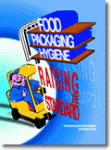
Food Packaging Hygiene - Raising the Standard
This fantastically illustrated and easy to understand 12 page, A5 full colour booklet conveys the essentials of Food Packaging Hygiene in a simple and effective style. The booklets are suitable as a handout for new employees and can also be used as a handy refresher for existing employees.
Booklet Contents:
- Hygiene Introduction
- Foreign Body Contamination
- Chemical Contamination
- Bacterial Contamination
- Personal Hygiene
- Cleaning
- Spot the Food Packaging Safety Hazards
- Quick Hygiene Quiz
Download Sample Pages >>

Lebensmittel Verpackungs Hygiene – Wir Heben Den Standard
This fantastically illustrated and easy to understand 12 page, A5 full colour booklet conveys the essentials of Lebensmittel Verpackungs Hygiene in a light hearted and effective style. The booklets are suitable as a handout for new employees and can also be used as a handy refresher for existing employees.
Booklet Contents:
- Warum ist hygienische Lebensmittelverpackung wichtig?
- Fremdkörper
- Chemikalien
- Bakterien
- Persönliche Hygiene
- Saubermachen
- Finden Sie die Sicherheitsrisiken für die Lebensmittelverpackung
- Hygiene-Schnellquiz
Download Sample Pages >>

Practical Food Safety Culture Training
Next Live Training: None scheduled
Alternatively purchase the previous training recording (with 30 day access) to experience the full 4-hour training session along with the presentation slides, templates, and certificate of attendance. Make you choice for live or recording during checkout.
Instructor: Vladimir Surčinski, Auditor and Trainer
Facilitator: Simon Timperley, Administrator, IFSQN
Cost per attendee: $97.00 USD
Training Course Outline:
The Practical Food Safety Culture 4-hour online training webinar is suitable for those wishing to implement a new Food Safety Culture system in their company as well as for those looking to gain knowledge on how to improve existing systems.
At the IFSQN we pride ourselves on providing practical training rather than theoretical. We are pleased to announce an online training webinar that will help you understand topic of Food Safety Culture and show you the steps to easy implement or improve Food Safety Culture.
In the first part of the training participants will receive general information on employee awareness, company culture, food safety systems and how these topics are main parts of the Food Safety Culture. In the first part participants will understand definitions, GFSI certification schemes requirements, and legal requirements EU, USA connected with Food Safety Culture.
In the second part of the training participants will receive instruction on developing an Food Safety Culture program, training and competence program and Food Safety Culture communication. The training will include practical examples and insight from the lead auditor perspective.
All attendees receive:
- Copy of the training materials (Slides and Templates)
- Personalized IFSQN Training Academy Certificate
- 30 day access to the webinar recording
- Exclusive post webinar contact with the presenter for further explanation and input
- Introduction to Food Safety Culture topic
- Importance of employee awareness
- What is Company Culture and how to recognize level of the same?
- History of Food Safety Culture and how it has become part of Food Safety System
- Definitions and understanding of requirements
- Food Safety Culture requirements in food standards (GFSI)
- Food Safety Culture in legislation EU, USA
- Main parts of the Food Safety Culture
- How to start with the implementation or improvement of Food Safety Culture
- Evaluation models of employee awareness and Food Safety Culture level
- Tools for Food Safety culture evaluation (questionnaires, SSAFE tools)
- Overview of the questions used in evaluation tools
- Development of strategies and objectives in connection with Food Safety Culture, Food Safety Culture Policy
- Development of employee engagement (open door model, communication box etc.)
- Employee training program
- Food Safety Culture communication with employees, top management, customers, and suppliers
- Internal audit as tool for improvement of Food Safety Culture
- Reporting, KPIs and trend analysis about Food Safety Culture
SQF Implementation Package for Food Manufacturers - Edition 9 (2022 Update)
This comprehensive documentation package is available for immediate download and is perfect for Food Manufacturers looking to meet SQF Food Safety Code: Food Manufacturing Edition 9. Everything you need to achieve SQF Certification!
Watch this product demonstration video for an overview of the extensive documentation, records templates, training, checklists and project implementation tools contained in our packages.
The IFSQN SQF Food Safety Management System Package is ideal for organizations looking to meet the requirements of the SQF Food Safety Code: Food Manufacturing Edition 9. In addition, this version has been updated in accordance with CODEX Recommended International Code of Practice General Principles of Food Hygiene 2020 Edition HACCP System and Guidelines for its Application.
The main documents are provided in Microsoft Word English (US) format and can be easily edited to suit your operation.
Included in the package:
- Food Safety Management System Procedures
A comprehensive set of editable Food Safety Management System Procedures written in Microsoft Word (US English) format - Good Manufacturing Practice Template Procedures
A comprehensive set of editable Good Manufacturing Practice Templates written in Microsoft Word (US English) format - Updated Food Safety Plan Procedures & Tools
A comprehensive Food Safety Plan Procedure & HACCP Calculator in accordance with CODEX General Principles of Food Hygiene 2020 Edition Chapter Two HACCP System and Guidelines for its Application. Plus a new 2022 Decision Tree. - Implementation Assistance
A range of tools including a Start-Up Guide, An Implementation Workbook, Instructions, Training Presentations, Guidance, Easy to use Record Templates and Technical Support
Food Safety Management System Procedures & Good Manufacturing Practice Template Procedures
The IFSQN SQF Food Safety Management System Package contains comprehensive top level Food Safety Management System procedures templates in Microsoft Word format that form the foundations of your Food Safety Management System so you don't have to spend 1,000's of hours writing compliant procedures.
These Food Safety Management System Templates match the clauses of the SQF Code and comply with Module 2 System Elements for Food Manufacturing and Module 11 Good Manufacturing Practices for Processing of Food Products.
The documents are provided in Microsoft Word English (US) format and are easily edited to suit your organization.
Updated Food Safety Plan Procedures & Tools
A comprehensive Food Safety Plan Procedure is provided in accordance with Codex General Principles of Food Hygiene 2020 Edition Chapter Two HACCP System and Guidelines for its Application.
An updated SQF HACCP Calculator and Instructions are included based on Codex 2020 Edition Chapter Two HACCP System and Guidelines for its Application plus a new 2022 Decision Tree as agreed by the Codex Committee on Food Hygiene in March 2022.
Implementation Assistance
- A Start-Up Guide - Edition 9 of the Package includes a Start-Up Guide which will guide you through the contents of the package.
- An Implementation Workbook - Provides a step-by-step guide to developing your SQF Food Safety Management System.
- Guidance - The package includes Food Safety Management System Compliance PowerPoint Training Presentations. These will help you understand where all the documents provided ensure your Food Safety Management System complies with the SQF Code.
- SQF 9 Implementation Plan - An SQF 9 Implementation Plan is included and can be used by Senior Management to plan the development of your SQF Food Safety Management System
- Laboratory Management Assistance - The package contains a supplementary comprehensive Laboratory Quality compliant with the requirements of ISO/IEC 17025 to compliment FS 2.4.4 Product Sampling, Inspection and Analysis. In Edition 9, the SQF Code requires internal laboratories that are used to conduct input, environmental, or product analyses, sampling and testing methods to be in accordance with the applicable requirements of ISO/IEC 17025. The Laboratory Quality Manual will prove very useful to Laboratories that are new to the requirements of ISO/IEC 17025.
- Assistance with Supplier Risk Assessment - The package contains documentation and tools that supplement FS 2.3.4 Approved Supplier Program including a Supplier & Material Risk Assessment Template.
- Assistance with Food Defense Assessment - The package contains a Food Defense Threat Assessment Template to supplement FS 2.7.1 Food Defense Plan procedure.
- Assistance with Food Fraud Assessment - The package contains a Food Fraud Assessment Template to supplement FS 2.7.2 Food Fraud procedure.
- Assistance with Internal Auditor Training - The package includes Internal Auditor and Inspection (GMP Audit) PowerPoint Training Presentations. There are also completed examples of corresponding Internal Audit and Good Manufacturing Practice Audit/Inspection Forms.
- Assistance with Complaint Management - The package contains a Complaints Analyzer Template, Instructions and Guidance to supplement FS 2.1.3 Complaint Management procedure.
- Free Online Technical Support - One of the unique features of our packages is that we provide technical support. This package includes online technical support and expertise to answer your questions and assist you in developing your SQF Food Safety and Management System until you achieve certification.
- IFSQN SQF 9 Food Safety Management System Implementation Workbook 2022 Sample
- IFSQN SQF 9 Food Safety Management System Start Up Guide 2022 Sample


Root Cause Identification and Problem Solving Tools in Food Safety
Next Live Training: None scheduled
Purchase the previous training recording (with 30 day access) to experience the full 4-hour training session along with the presentation slides, templates, and certificate of attendance.
Training Instructor:
Vladimir Surčinski, Auditor and Trainer for Food Standards, IFSQN
Food Safety expert with more than 10 years in food safety topics and implementation, training and auditing business. Food safety standards are my focus, still strongly included in standards for quality, environmental protection and health and safety. Currently on position of project manager for certification body of Quality Austria where I am also accredited auditor and trainer with more than 500 audits performed in different industries and more than 1,000 persons trained. I have a vision of finding new ways to analyse risks in food safety and defining of methods that will be used in industries across the world. My strategy is to develop and research new topics in food safety, presenting them through the webinars, training's, forums, blogging and publications.
Through the webinar four practical tools are presented:
- PARETO Analysis - The basic underlying rule behind the Pareto principle is that in almost every case, 80% of the total problems incurred are caused by 20% of the problem causes. Therefore, by concentrating on the major problems first, you can eliminate the majority of your problems. The few problems that occur most often result in the majority of your defects.
- FMEA - Failure Modes and Effects Analysis (FMEA) is a systematic, proactive method for evaluating a process to identify where and how it might fail and to assess the relative impact of different failures, in order to identify the parts of the process that are most in need of change.
- ISHIKAWA diagram - A fishbone diagram, also called a cause and effect diagram, is a visualization tool for categorizing the potential causes of a problem in order to identify its root causes.
- 8-D - The eight disciplines (8D) model is a problem solving approach typically employed by quality engineers or other professionals and commonly used by the production industry. Its purpose is to identify, correct, and eliminate recurring problems, and it is useful in product and process improvement.
Training course outline:
This training is specially developed for the webinar system of learning on IFSQN. The main goal of the webinar is to give participants more practical than theoretical knowledge through clear and simple examples and also through engaging the participants in discussion.
The webinar provides instructions on how to implement simple tools in everyday activities, how to use the tools in risk analyzing, root cause identification and problem solving.
The webinar is suitable for employees responsible for production management, supervisors, managers in food safety, food safety team members, consultants for management systems, and other interested persons that work in food chain and that are responsible for analyzing and problem solving in a food safety context..
The course is delivered in 4 sections:
1. Introduction to the food standards demands about collection of nonconformities and corrective actions with root cause identification (practical use of PARETO analyzing)
2. Practical use of Failure Mode and Effect Analysis (definition, benefits and targets, procedure, key figures, form sheets)
3. Practical use of ISHIKAWA diagram (definition, procedure, form sheets, root cause analyzing)
4. Practical use of 8-D problem solving (definition, approach to problems, problem solving, worksheets)
Online test - finalization and evaluation of webinar
All attendees receive:
• Copy of the training materials (Slides and Templates)
• Personalized IFSQN Training Academy Certificate
• 30 day access to the webinar recording
List of topics covered:
- Introduction to the food standards demands (general and specific)
- Food standards that will be covered during the presentation
- Definition in each standard and specific requirements regarding internal and external risk and opportunities
- Practical use of PARETO analyzing
- Definition of PARETO
- Use of PARETO analyzing
- Use of worksheets and examples
- Practical examples
- Practical use of FMEA
- Basic concept
- Definition – what is FMEA?
- Why FMEA?
- Benefits and targets of FMEA
- Types of FMEA (use in food safety)
- Procedure
- Key figures
- Launch and training of FMEA
- Phase model DAMUK
- FMEA Form sheet
- Practical use of ISHIKAWA diagram
- Definition and use
- Why ISHIKAWA?
- Procedure for nonconforming products
- Benefits and targets (use in food safety root cause)
- ISHIKAWA diagram and model
- Practical use of 8-D problem solving
- Definition and use
- 8-D model in food safety
- Procedure of customer complaint and withdrawals
- Worksheets

GFSI requirements for Allergen Management in Food Production
Next Live Training: None scheduled
Purchase the previous training recording (with 30 day access) to experience the full 4-hour training session along with the presentation slides, templates, and certificate of attendance. Make you choice for live or recording during checkout.
Instructor: Vladimir Surčinski, Auditor and Trainer
Facilitator: Simon Timperley, Administrator, IFSQN
Cost per attendee: $97.00 USD
Training Course Outline:
In the last two decades, the prevalence of allergic diseases have increased dramatically. It is estimated that over 220 million people worldwide have experienced reactions to food allergens. Lack of understanding of allergens hazards in the process of purchasing, storage, preparation ordering, and delivering of food products can lead to unwanted allergenic reactions for immunocompromised consumers. These were the main reasons for food legislation and significant food safety standard requirements change.
Allergens are now considered as one of the significant hazards. Steps in production need to be assessed for potential cross-contamination and verification methods need to be developed. All this needs to comply with legislation and food safety standard requirements which brings additional pressure for food operators and managers.
With this 4-hour training webinar, we offer you an easy and fast way to understand what allergens are, how cross-contamination can happen, ways to prevent it, to control it, and to develop a strong food safety system that can build the confidence of consumers.
All attendees receive:
- Copy of the training materials (PDF)
- Personalized IFSQN Training Academy Certificate
- 30 day access to the webinar recording
- Exclusive post webinar contact with the presenter for further explanation and input
- Food allergies definition, reason and indicators
- Main food products that are allergens
- Understanding the gluten allergies and intolerance
- Egg and egg product allergies
- Milk and milk product allergies
- Fish and sea products allergies
- Soy allergies
- Nut allergies
- Sesame allergies
- SO2 allergies
- Understanding the minimal and maximal dosage of allergens in food
- Food safety system requirements for allergen hazards – GFSI certification scheme
- Implementation of prevention steps for cross-contamination (layout, equipment design, cleaning activities etc.)
- Organisation of production steps and production lines in accordance with allergen management
- Organisation of employees and employee training regarding allergens
- Practical examples of hazard assessment for allergen hazard in production steps
- Implementation of allergen monitoring activities
- Implementation of allergen verification activities
- Analysis and understanding of the allergen verification activities
- Analytical methods for allergen verification
- Development of records and procedures for allergen management
- Understanding of the basic legislation regarding the allergens labelling
- Final products labelling and consumer awareness

Food Safety & Hygiene Training for Food Handlers
Next Live Training: None scheduled
Purchase the previous training recording (with 30 day access) to experience the full 4-hour training session along with the presentation slides, templates, and certificate of attendance. Make you choice for live or recording during checkout.
Instructor: Tony Connor, Chief Technical Advisor, IFSQN
Facilitator: Simon Timperley, Administrator, IFSQN
Cost per attendee: $57.00 USD
Training Course Outline:
The Food Safety and Hygiene Training Webinar for Food Handlers is a BASIC LEVEL program and is suitable for all personnel working in food manufacturing, food handling, food storage or food distribution operations providing the fundamental knowledge on food safety and hygiene.
The training webinar may be used as part of new starter induction or as a refresher for all staff as part of an ongoing food safety training program.
The training program consists of a 2 hour webinar with four presentations, polls and question and answer sessions. After the webinar there is an online exam and an IFSQN Academy certificate is awarded to all candidates that pass the exam.
All attendees receive:
- Copy of the training material
- Personalized IFSQN Training Academy Certificate awarded on successful completion of the course and end test
- 7 day access to the webinar recording
1. Introduction to Food Safety and Hygiene
2. Food Contamination
3. Prevention of Contamination
4. Summary and Rules
5. Online Exam
1. Introduction to Food Safety and Hygiene
- What is food safety?
- What is food hygiene?
- What happens when things go wrong?
- Principles of food hygiene
2. Food Contamination
- Causes of food poisoning
- Types of contamination
- Common food poisoning bacteria
- Where contamination comes from
- Vehicles of cross-contamination
3. Prevention of Contamination
- Hygiene policy
- Hand washing
- Physical and chemical controls
- Food premises and equipment
- Maintenance
- Operational controls
- HACCP
- Critical control points
- Storage and temperature controls
- Pest control
- Cleaning
- Waste control
- Employee’s responsibilities
4. Summary and Rules
- Conclusion
- Ten rules of food safety and hygiene
5. Online Exam
Competency and understanding is verified by a 25 minute online exam consisting of 25 multiple choice questions covering the topics taught in the course.

Nurturing a Behavioral Based Food Safety Culture
Next Live Training: None scheduled
Purchase the previous training recording (with 30 day access) to experience the full 4-hour training session along with the presentation slides, templates, and certificate of attendance.
Instructor: Dr. David Rosenblatt, Training Specialist, Sher Consulting and Training
Facilitator: Simon Timperley, Administrator, IFSQN
Cost per attendee: $97.00 USD
Training Course Outline:
The "Nurturing a Behavioral Based Food Safety Culture" Webinar is suitable for all decision makers anywhere along the food and feed supply chain from farm to fork.
This Webinar will be especially beneficial for high level managers, HR personnel, food safety managers, trainers and consultants.
The training program consists of a 3-hour webinar with polls and question and answer sessions. After the Webinar there is an online test covering the topics taught in the course. An IFSQN Academy certificate is awarded to all candidates that pass the exam.
Over and over again out industry faces food safety incidents that, in hindsight, were 100% preventable. This occurs in organizations certified to high level standards which include an in-depth HACCP program.
Root cause analysis most often uncovers human behavior as the source of failure; however, we now understand that the roots go much deeper. How is it possible that the same person, with the same knowledge and the same background, faced with the same set of rules and regulations, will behave differently in two different organizations?
Neuroscience is now providing learning specialists a new understanding of what makes people do what they do and how it is connected to organizational culture.
All attendees receive:
- Copy of the training material (PDF)
- Personalized IFSQN Training Academy Certificate awarded on successful completion of the course and end test
- 30 day access to the webinar recording
- Case studies
- Fundamentals of employee behavior: human error and forgetfulness, competence and motivation
- Characteristics of a food safety culture and how they affect behavior
- The building blocks of culture: leadership, symbols of uniformity (icons, uniforms, language, ritual), behavioral procedures, employee involvement
FSSC 22000 Food Safety Management System for Food Manufacturers - Version 6
This is our premiere package for Food Manufacturers looking to achieve certification to FSSC 22000. Food Safety System Certification (FSSC) 22000 is a Global Food Safety Initiative (GFSI) approved certification scheme for food manufacturers based on the integration of the ISO 22000 food safety management standard, Technical Specification TS ISO 22002 part 1 Prerequisite Programmes for Food Manufacturers and Food Safety System Certification (FSSC) 22000 Additional Requirements for certification Version 6.
The package content covers new requirements in FSSC 22000 Additional Requirements Version 6 including Allergen Management, Environmental Monitoring Program, Food Safety & Quality Culture, Quality Control, Foreign Matter Management, Equipment Management, Food Loss & Waste and Communication Requirements.
In addition, this version has been updated in accordance with CODEX Recommended International Code of Practice General Principles of Food Hygiene 2022 Edition HACCP System and Guidelines for its Application including a New Decision Tree.
Watch this product demonstration video for an overview of the extensive documentation, records templates, training, checklists and project implementation tools contained in our packages.
Included in the package:
- Food Safety Management System Procedures
A comprehensive set of editable Food Safety Management System Procedures written in Microsoft Word format that are compliant with International Standard ISO 22000:2018 Food safety management systems - Requirements for any organization in the food chain and FSSC 22000 Certification Scheme Additional Requirements Version 6 - Prerequisite Programme Template Procedures
A comprehensive set of editable Prerequisite Programme Template Procedures written in Microsoft Word format that are compliant with Technical Specification TS ISO 22002 part 1 Prerequisite Programmes for Food Manufacturers and FSSC 22000 Certification Scheme Additional Requirements Version 6 - Operational Prerequisite Programmes Manual
A set of editable Operational Prerequisite Programme Procedures and corresponding Validation & Verification Records - Food Safety Record Templates
A wide range of editable FSMS, Validation and Verification Record Templates written in Microsoft Word format - Training
An extensive set of IFSQN PowerPoint Training Presentations including:- Introduction to ISO 22000:2018
- ISO 22000:2018 Documentation Requirements
- Good Hygienic Practices – New extensive 2022 update
- Prerequisite Programmes
- Implementing ISO 22000:2018 Food Safety Team Guide 2022 Update
- HACCP Training Guide ISO 22000:2018 Version 2022 Update
- FSSC 22000 Additional Requirements Version 6
- Internal Auditor Training Guide
- Example Internal Audit Training Guide
- GMP Auditor Training Guide
- Implementation Assistance
A range of tools that assist in developing your Food Safety Management System including instructions, guidance and technical support. There are also supporting supplementary modules for the prerequisite programmes:- Allergen Management
- Product Development
- Supplier Risk Assessment
- Laboratory Quality Manual based on the requirements of ISO 17025
- Additional FSSC 22000 HACCP Documentation including updated FSSC 22000 HACCP Calculator and Extensive Instructions
- Internal Audit Checklists/ Facility Inspection/GMP Audit Forms
- ISO 22000 & ISO 22002 Audit Plans with Risk Rating System/Facility Inspection Schedule
- Food Defence Procedures & Assessment Tool
- Food Fraud Prevention Procedures & Fraud Assessment Tools
- Complaint Management Guidance, Complaint Analyser & Instructions
- FSSC 22000 Implementation Package Start Up Guide
We provide a Start Up Guide to help you navigate around the package and get to understand the contents - New Comprehensive Version 6 Implementation Workbook
The workbook includes extensive Top Management and Food Safety Team Implementation Guidance plus final step gap analysis checklists for ISO 22000 food safety management standard, TS ISO 22002-1 Prerequisite Programmes for Food Manufacturers and FSSC 22000 Additional Requirements Version 6. - Free online support via e-mail
We provide online support and expertise to assist you in developing your FSSC 22000 Food Safety Management System. Support is guaranteed until you achieve certification
- IFSQN FSSC 22000 Food Implementation Workbook V6 Sample
- IFSQN FSSC 22000 Food Implementation Package V6 Start Up Guide Sample
Essential 22000 HACCP Training Course
The Essential 22000 HACCP Training Course is an INTERMEDIATE LEVEL program covering all the elements of best practices in implementing a HACCP system and is suitable for anyone involved in food manufacturing, storage and/or food distribution operations wishing to comply with ISO 22000 or FSSC 22000 HACCP requirements.
HACCP training needs to ensure that food safety team members have the skills and knowledge to assist in implementing a HACCP system. Training your food safety team in HACCP implementation and best practices is an important step to developing a sound HACCP system. Failing to train your staff properly increases the risk of poor food safety; this can lead to customer dissatisfaction, potentially huge legal costs and the loss of reputation and market share.
This training course can be taken individually and at any time and so you can train staff at a time convenient to both employers and employees. It is in a format that can be taken on a PC and/or a variety of smart devices.
Most businesses need to train staff quickly and do not have the resources to run training courses. As our HACCP course and exam are web based and delivered online, these problems are easily overcome.
For a flavor of the training course watch this short demonstration video.
What is the Object of the Course?
The object of the course is to develop knowledge of the principles of HACCP, and train food safety team members in industry best practices in implementing a HACCP system from preliminary steps to documenting a HACCP plan. The course also covers the selection and assessment of control measures as per ISO 22000 requirements and how control measures are categorized as being managed through operational PRP(s) or by the HACCP plan. Competency and understanding is verified by online exam upon completion of the course.
Course outline:
- Online training module consisting of 1 hour 45 minute instructional video followed by a 30 minute exam
- Suitable for all food handlers providing the fundamental knowledge on food safety and HACCP
- Can be used for new HACCP team member training or as refresher training for all staff as part of an ongoing food safety training program
- An IFSQN Training Academy Certificate is awarded to all participants on successful completion of the course
Personnel working in food manufacturing, food handling, food storage or food distribution operations.
How is the course delivered?
The course is delivered by 1 hour 45 minutes of video in 7 parts:
1. Introduction to HACCP
2. Contamination
3. Terms and Definitions
4. Preliminary Steps
5. Prerequisite Programs
6. HACCP Principles
7. Operational Prerequisite Programs
What is the Assessment Criteria?
Each candidate is assessed by a 30 minute online exam. An individual login is provided for each candidate and the questions are varied and randomized. The exam consists of 30 multiple choice questions covering the topics taught in the course. A mark of 70% or more is required to receive a certificate.
What are the Topics Covered?
Part 1 - Introduction to HACCP:
- Introduction
- Why Food Safety is important
- Introduction to CODEX General Principles of Food Hygiene
- Types of contamination
- Where contamination comes from
- Types of Hazard
- Biological Hazards
- Common food poisoning bacteria
- Chemical Hazards
- Physical Hazards
- HACCP Terms
- HACCP Definitions
- HACCP Terms and Definitions Examples
- The HACCP team
- Product Description
- Intended Use
- Consumers
- HACCP Scope
- Process Flow Diagram
- Flow Diagram Verification
- Prevention of contamination
- Hygiene policy
- Physical and chemical controls
- Food premises and equipment
- Maintenance
- Operational controls
- Storage and temperature controls
- Pest control
- Cleaning
- Waste control
- Conducting a hazard analysis
- Hazard Assessment
- Identifying the Critical Control Points
- HACCP Decision Tree
- Establishing Critical Limits
- HACCP Validation
- Establishing a Monitoring System
- Establishing Corrective Actions
- Establishing HACCP Documentation
- HACCP Verification
How to implement HACCP as per the requirements of ISO 22000 including how to categorize controls measures as either CCPs, OPRPs or PRPs.
How do I enroll?
Simply purchase the desired number of courses by adding to the cart. If you want to enroll multiple candidates you will need to add their details to the enrollment form and email it to support@ifsqn.com.
Once we receive payment you will be forwarded an email with detailed instructions on how to take the course.
Download enrollment form >>
BRCGS Food Safety and Quality Management System for Food Manufacturers - Issue 9
This comprehensive yet simple Food Safety Management System Package contains EVERYTHING you will need to meet the requirements and achieve certification to the BRCGS - Food Safety (Issue 9).
Watch this product demonstration video for an overview of the extensive documentation, records templates, training, checklists and project implementation tools contained in our packages.
The IFSQN BRCGS Food Safety & Quality Management System Package is ideal for organizations looking to meet the requirements of the BRCGS Global Standard for Food Safety Issue 9. This version has been updated in accordance with CODEX Recommended International Code of Practice General Principles of Food Hygiene 2020 Edition HACCP System and Guidelines for its Application.
The main documents are provided in Microsoft Word English format and can be easily edited to suit your operation.
Included in the package:
- Food Safety Management System & Prerequisite Programme Procedures
A comprehensive set of editable Food Safety Management System Procedures written in Microsoft Word format that match every clause of the 9 sections of the BRCGS Global Standard for Food Safety Issue 9 - Updated Food Safety Plan Procedures & Tools
A comprehensive Food Safety Plan Procedure & HACCP Calculator in accordance with CODEX General Principles of Food Hygiene 2020 Edition Chapter Two HACCP System and Guidelines for its Application. Plus a new 2022 Decision Tree. - Implementation Assistance
A range of tools including a Start-Up Guide, An Implementation Workbook, Instructions, Training Presentations, Guidance, Easy to use Record Templates and Technical Support
Food Safety Management System Procedures & Prerequisite Programme Template Procedures
The IFSQN BRCGS Food Safety & Quality Management System Package contains comprehensive top level Food Safety Management System procedures templates in Microsoft Word format that form the foundations of your Food Safety Management System so you don't have to spend 1,000's of hours writing compliant procedures.
These Food Safety Management System Templates match the clauses of the BRCGS Global Standard for Food Safety Issue 9.
The documents are provided in Microsoft Word English format and are easily edited to suit your organization.
Updated Food Safety Plan Procedures & Tools
A comprehensive Food Safety Plan Procedure is provided in accordance with the Standard and Codex General Principles of Food Hygiene 2020 Edition Chapter Two HACCP System and Guidelines for its Application.
An updated BRCGS HACCP Calculator and Instructions are included based on Codex 2020 Edition Chapter Two HACCP System and Guidelines for its Application plus a new 2022 Decision Tree as agreed by the Codex Committee on Food Hygiene in March 2022.
Implementation Assistance
- A Start-Up Guide – Issue 9 version of the Package includes a Start-Up Guide which will guide you through the contents of the package.
- An Implementation Workbook - Provides a step-by-step guide to developing your BRCGS Food Safety & Quality Management System.
- Guidance - The package includes Food Safety Management System Compliance PowerPoint Training Presentations. These will help you understand where all the documents provided ensure your Food Safety Management System complies with the BRCGS Code.
- BRCGS 9 Implementation Plan – A comprehensive BRCGS 9 Implementation Plan is included and can be used by Senior Management to plan the development of your BRCGS Food Safety Management System
- Laboratory Management Assistance - The package contains a supplementary comprehensive Laboratory Quality compliant with the requirements of ISO/IEC 17025 to compliment FS 5.6A Product Inspection, Testing and Analysis. BRCGS Global Standard requires internal laboratories that are used to conduct input, environmental, or product analyses, sampling and testing methods to be in accordance with the applicable requirements of ISO/IEC 17025. The Laboratory Quality Manual will prove very useful to Laboratories that are new to the requirements of ISO/IEC 17025.
- Assistance with Supplier Risk Assessment - The package contains documentation and tools that supplement FS 3.5 Supplier and Raw Material Approval and Monitoring including a Supplier & Material Risk Assessment Template.
- Assistance with Food Defence Assessment - The package contains a Food Defence Threat Assessment Template to supplement FS 4.2 Food Defence procedure.
- Assistance with Food Fraud Assessment - The package contains FS 5.4 Food Fraud Raw Material Assessment Tool to supplement FS 5.4 Product Authenticity, Claims & Chain of Custody procedure.
- Assistance with Internal Auditor Training - The package includes Internal Auditor and Inspection (GMP Audit) PowerPoint Training Presentations. There are also completed examples of corresponding Internal Audit and Good Manufacturing Practice Audit/Inspection Forms.
- Assistance with Complaint Management - The package contains a Complaints Analyser Template, Instructions and Guidance to supplement FS 3.10 Management of Customer Complaints procedure.
- Free Online Technical Support - One of the unique features of our packages is that we provide technical support. This package includes online technical support and expertise to answer your questions and assist you in developing your BRCGS Food Safety and Quality Management System until you achieve certification.
BRCGS Implementation Workbook Issue 9 2022
BRCGS Food Safety & Quality Management System Start Up Issue 9

Complaint Management & Performance Improvement Training
Next Live Training: None scheduled
Purchase the previous training recording (with 30 day access) to experience the full 4-hour training session along with the presentation slides, templates, and certificate of attendance.
This webinar will enable participants to develop practical knowledge of complaint management. The webinar provides instruction on how to implement a complaint management system, how to investigate complaints, how to collate complaint data and how to analyze complaint data using the complaint trend analysis tools provided to identify areas of concern that need to be addressed and opportunities for improvement.
Instructor: Tony Connor, Chief Technical Advisor, IFSQN
Facilitator: Simon Timperley, Administrator, IFSQN
Cost per attendee: $97.00 USD
Training Course Outline:
Complaint handling is included in Food Safety Management Requirements of the GFSI Guidance Document and as such is a compulsory element of GFSI benchmarked standards including BRC, SQF, IFS and FSSC 22000.
The capture and analysis of complaints is a tool for identifying deficiencies in the effectiveness of your food safety management system. Complaint levels are a key performance indicator and reflect the effectiveness of the food safety management system. Customer complaints can provide an insight into site performance and any areas that may require greater focus.
Effective complaint management requires procedures to ensure that customer complaints are captured, recorded, investigated, responded to, complaint trends are investigated and corrective and/or preventive actions. Actions should be proportionate to the seriousness and frequency of the problems identified and carried out promptly by appropriately trained staff.
In this webinar, we will cover the elements of a complaint management system and show how analysis of complaints can provide useful information to identify and correct non-conformity and demonstrate continuous improvement.
We will show you tried and trusted systems, that have been developed over 25 years, to analyze complaint data to identify food safety issues and adverse trends in complaints. The training includes an Annual Complaint Analyzer which will assist participants in future Complaint Analysis and Complaint Performance Improvement.
There will be practical examples demonstrated and a question and answer session to discuss any difficulties that you may have with complaint management and performance improvement.
The course is suitable for all personnel working in food manufacturing, food handling, food storage or food distribution operations.
All attendees receive:
- A copy of the training material (PDF)
- Personalized IFSQN Training Academy Certificate
- Complaint Procedure and Investigation Form Templates
- Complaint Analysis Templates
- Annual Complaint Trend Analyzer
- 30-day access to the webinar recording
- Introduction - Importance of Complaint Management
- GFSI & GFSI Benchmarked Standards Complaint Management Requirements
- Establishing an Effective Complaint Management System
- How effective Good Manufacturing Practices and Factory Inspections reduce complaint numbers
- Analysis of Complaints
- Complaint Performance Improvement
- Attitude
- The Process
- Communication Channels
- On Pack Information
- Capture/Receipt
- Complaint Form
- Initial Response
- Investigation
- Corrective Action
- Response
- Summarizing complaints by product and type
- Complaint analysis (week, month, year)
- Complaint trend analysis
- Implementing actions to improve your complaint performance
- Complaint Trend Analysis Tool!
SQF (& FSMA) Implementation Package for Food Manufacturers - Edition 9 (2023 Update)
This comprehensive documentation package is available for immediate download and is perfect for Food Manufacturers looking to meet SQF Food Safety Code: Food Manufacturing Edition 9 and the SQF Addendum for the Preventive Controls for Human Food Rule. Everything you need to achieve SQF Certification!
Watch this product demonstration video for an overview of the extensive documentation, records templates, training, checklists and project implementation tools contained in our packages.
See SQF Earns Recognition by the U.S. Food and Drug Administration - FDA FSMA Preventative Controls of Human Food Rule for further information on how sites that achieve SQF Certification with the SQF FSMA addendum benefit from increased confidence that SQF adequately addresses applicable FDA food safety requirements.
This 2023 Version of the IFSQN SQF Code Edition 9 & FSMA Implementation Package for Food Manufacturers has also been updated in accordance with CODEX Recommended International Code of Practice General Principles of Food Hygiene 2022 Edition HACCP System and Guidelines for its Application which includes a New Decision Tree.
The main documents are provided in Microsoft Word English (US) format and can be easily edited to suit your operation.
Included in the package:
- Food Safety Management System Procedures - A comprehensive set of editable Food Safety Management System Procedures written in Microsoft Word (US English) format
- Good Manufacturing Practice Template Procedures - A comprehensive set of editable Good Manufacturing Practice Templates written in Microsoft Word (US English) format
- Food Safety Record Templates - A wide range of easy to use Record Templates written in Microsoft Word (US English) format
- Implementation Assistance - A range of tools including a Start-Up Guide, An Implementation Workbook, Instructions, Training Presentations, Guidance and Technical Support
Food Safety Management System Procedures & Good Manufacturing Practice Template Procedures
The IFSQN SQF & FSMA Food Safety Management System Package contains comprehensive top level Food Safety Management System procedures templates in Microsoft Word format that form the foundations of your Food Safety Management System so you don't have to spend 1,000's of hours writing compliant procedures.
These Food Safety Management System Templates match the clauses of the SQF Code and comply with System Elements for Food Manufacturing and Module 11 Good Manufacturing Practices for Processing of Food Products, SQF Addendum for the Preventive Controls for Human Food Rule and CODEX COP HACCP System and Guidelines for its Application 2022 Edition.
The documents are provided in Microsoft Word English (US) format and are easily edited to suit your organization.
Food Safety Record Templates
A wide range of easy to use Food Safety Record Templates written in Microsoft Word (US English) format. Additionally, there are also a range of sample validation and verification records.
There are also allergen management, laboratory, HACCP and product development records.
Implementation Assistance
- A Start-Up Guide - Edition 9 of the Package includes a Start-Up Guide which will guide you through the contents of the package.
- An Implementation Workbook - Provides a step-by-step guide to developing your SQF Food Safety Management System.
- Guidance - The package includes Food Safety Management System Compliance PowerPoint Training Presentations. These will help you understand where all the documents provided ensure your Food Safety Management System complies with the SQF Code.
- SQF 9 Implementation Plan - An SQF 9 Implementation Plan is included and can be used by Senior Management to plan the development of your SQF Food Safety Management System
- HACCP Assistance – Additional Documentation & Tools
- There are supplementary instructions, a HACCP training presentation, guidance and documentation to supplement Food Safety Management System Document FS 2.4.3 Food Safety Plan (21 page HACCP procedural template) including the SQF 9 CODEX FSMA HACCP Calculator 2023 and instructions.
- Laboratory Management Assistance - The package contains a supplementary comprehensive Laboratory Quality Manual compliant with the requirements of ISO/IEC 17025 to compliment FS 2.4.4 Product Sampling, Inspection and Analysis. In Edition 9, the SQF Code requires internal laboratories that are used to conduct input, environmental, or product analyses, sampling and testing methods to be in accordance with the applicable requirements of ISO/IEC 17025. The Laboratory Quality Manual will prove very useful to Laboratories that are new to the requirements of ISO/IEC 17025.
- Assistance with Supplier Risk Assessment - The package contains documentation and tools that supplement FS 2.3.4 Approved Supplier Program including a Supplier & Material Risk Assessment Template.
- Assistance with Food Defense Assessment - The package contains a Food Defense Threat Assessment Template to supplement FS 2.7.1 Food Defense Plan procedure.
- Assistance with Food Fraud Assessment - The package contains a Food Fraud Assessment Template to supplement FS 2.7.2 Food Fraud procedure.
- Assistance with Internal Auditor Training - The package includes Internal Auditor and Inspection (GMP Audit) PowerPoint Training Presentations. There are also completed examples of corresponding Internal Audit and Good Manufacturing Practice Audit/Inspection Forms.
- Assistance with Complaint Management - The package contains a Complaints Analyzer Template, Instructions and Guidance to supplement FS 2.1.3 Complaint Management procedure.
- Free Online Technical Support - One of the unique features of our packages is that we provide technical support. This package includes online technical support and expertise to answer your questions and assist you in developing your SQF Food Safety and Management System until you achieve certification.
- FSMA Hazard Analysis & Preventive Controls
- There is an SQF FSMA and Preventive Controls Presentation which gives Guidance for the Implementation of the Preventive Controls in addition to Critical Control Points and developing a Food Safety Plan.
- The HACCP documentation, guidance and tools provided assist with the Identification of CCPs and Preventive Controls enabling you to create your Food Safety Plans
- There is Guidance for the Implementation of Supply Chain Controls
- Follow the step by step guide to implementing your HACCP/Food Safety Plans using the documents and tools provided.
• IFSQN SQF 9 & FSMA Food Safety Management System Implementation Workbook 2023 Update Sample
• IFSQN SQF 9 & FSMA Food Safety Management System Start Up Guide 2023 Update Sample

Traceability, Withdrawal Management and Root Cause Analysis tools
Next Live Training: None scheduled
Purchase the previous training recording (with 30 day access) to experience the full 4-hour training session along with the presentation slides, templates, and certificate of attendance.
Instructor: Vladimir Surčinski, Auditor and Trainer
Facilitator: Simon Timperley, Administrator, IFSQN
Cost per attendee: $97.00 USD
Training Course Outline:
Sometimes traceability is hard to understand and to implement. Specifically, in food production systems that include a large number of ingredients, packaging materials, and production steps. When traceability is not set right it becomes hard to perform activities such as recall or withdrawal of products.
In the certification process not understanding these processes and not implementing them correctly can lead to the nonconformities and even the loss of certification. In real-life situations, lack of understanding can lead to sanctions, loss of customer confidentiality, and business crisis.
With this webinar, we offer you the easiest way to understand traceability, recall, withdrawal, and how to implement them in a comprehensive way in your food production. Through the webinar, attention is given to the tools that you can use in everyday operations to find Root Causes and to prevent any further potential recall or withdrawal.
In this 4-hour training course, you will understand how to implement a traceability system in your food production, you will be able to simulate the recall/withdrawal process with a high success rate and your organization will have fast tools for finding and solving root causes that affects stability of the food safety system.
All attendees receive:
- Copy of the training materials (PDF)
- Personalized IFSQN Training Academy Certificate
- 30 day access to the webinar recording
- Exclusive post webinar contact with the presenter for further explanation and input
- World trends that affect food industry changes
- Changes that follow in certification schemes – GFSI
- Different regulations and laws regarding food traceability
- GFSI certification schemes traceability requirements (IFS, BRC, SQF, FSSC, Global GAP)
- ISO 22000 traceability requirements
- Main steps in developing traceability in food production
- Practical examples of different types of traceability in food production
- Identification and traceability of raw ingredients
- Identification and traceability of packaging materials
- Semi-finished products traceability
- Final product labeling, identification, and traceability
- Developing of records and procedures for traceability
- Modern methods for traceability (QR codes, RFID, software tools etc.)
- Understanding recall and withdrawal requirements – legislation
- Understanding recall and withdrawal requirements – certification schemes GFSI, ISO
- Developing procedures and implementation steps for recall and withdrawal
- How to perform simulation/mock recall and withdrawal
- Developing records for recall and withdrawal
- Analysis tools to help decide when to perform recall and withdrawal
- Practical tools for root cause identification
- Implementation of corrective action plans and prevention of potential business losses

Implementing ISO & FSSC 22000
Next Live Training: None scheduled
Purchase the previous training recording (with 30 day access) to experience the full 4-hour training session along with the presentation slides, templates, and certificate of attendance.
The Implementing ISO & FSCC 22000 Live Training Webinar is an INTERMEDIATE LEVEL program covering all the elements of implementing an ISO 22000 or FSSC 22000 food safety management system and is suitable for anyone involved in food manufacturing, storage and/or food distribution operations wishing to comply with ISO 22000 or FSSC 22000 requirements.
Instructor:
Tony Connor, Chief Technical Advisor, IFSQN
Facilitator: Simon Timperley, Administrator, IFSQN
Cost per attendee: $97.00 USD
Training Course Outline:
The object of the course is to develop knowledge and understanding of the ISO 22000 standard, the FSSC 22000 Certification Scheme and best practices in implementing a compliant food safety management system. The course also covers the selection and assessment of control measures as per ISO 22000 requirements and how control measures are categorized as being managed through prerequisites, operational PRP(s) or by the HACCP plan. Competency and understanding is verified by online exam upon completion of the course.
The live webinar will include question and answer sessions throughout and a video recording will be available to watch for up to 30 days after the webinar.
All attendees receive:
• Copy of the training material (PDF)
• Personalized IFSQN Training Academy Certificate awarded on successful completion of the course and end test
• 30 day access to the webinar recording
How is the course delivered?
The course is delivered in 10 parts including 9 presentations
- Introduction to ISO 22000
- ISO 22000 Document Requirements
- Understanding ISO 220000
- Implementing ISO 22000 Food Safety Team Guide
- CODEX Code of Practices
- Prerequisite Programmes
- Operational Prerequisite Programmes
- HACCP Implementation
- Additional Requirements for FSSC 22000 Certification
- Online Exam
Each candidate is assessed by a 30 minute online exam. An individual login is provided for each candidate and the questions are varied and randomized. The exam consists of 30 multiple choice questions covering the topics taught in the course. A mark of 70% or more is required to receive a certificate.
Topics include:
ISO 22000 Requirements
4. Food Safety Management System
4.1 General Requirements
4.2 Documentation
4.2.2 Document Control
4.2.2 Document Control
4.2.3 Record Control
5. Management Responsibility
5.1 Management Commitment
5.2 Food Safety Policy
5.3 FSQMS Planning
5.4 Responsibility & Authority
5.5 Food Safety Team Leader
5.6 Communication
5.6.1 External Communication
5.6.2 Internal Communication
5.7 Contingency preparedness and response
5.8 Management Review
6. Resource Management
6.1 Provision of Resources
6.2 Human Resources
6.2.2 Competence, Awareness and Training
6.3 Infrastructure
6.4 Work Environment
7. Planning and Realisation of Safe Products
7.1 General Planning and Realisation of Safe Products
7.2 Prerequisite Programmes:
a) construction and lay-out of buildings and associated utilities
b) lay-out of premises, including workspace and employee facilities
c) supplies of air, water, energy and other utilities
d) supporting services, including waste and sewage disposal
e) the suitability of equipment and its accessibility
f) management of purchased materials, supplies, disposals and handling of products
g) measures for the prevention of cross contamination
h) cleaning and sanitizing
i) pest control
j) personnel hygiene
k) other aspects as appropriate
7.3 Preliminary steps to enable Hazard analysis
7.4 Hazard Analysis
7.5 Operational Control
7.5 Establishing the Operational PRPs
7.5 Establishing the Operational Pre-requisites
7.6 Establishing the HACCP plan
7.7 Updating of preliminary information and documents specifying the PRP(s) and HACCP plan
7.8 Verification Planning
7.9 Traceability System
7.10.1 Corrections
7.10.2 Corrective Actions
7.10.3 Handling of Potentially unsafe products
7.10.4 Withdrawals
8. Validation, Verification and Improvement of the FSMS
8.1 General
8.2 Validation of Control Measure Combinations
8.3 Control of Monitoring and Measuring
8.4 FSQMS Verification
8.4.1 Internal audits
8.4.2 Evaluation of Individual Verification results
8.4.3 Analysis of results of Verification activities
8.5 Improvement
8.5.1 Continual Improvement
8.5.2 FSQMS updating
FSSC 22000 Requirements
ISO 22002-1 Prerequisite programmes on food safety — Part 1: Food Manufacturing Programmes
Additional FSSC Requirements

Best Practices in Preventive Controls for Food Safety
Next Live Training: None scheduled
Purchase the previous training recording (with 30 day access) to experience the full 4-hour training session along with the presentation slides, templates, and certificate of attendance.
Preventive controls, good manufacturing practices and prerequisite programmes are terms used to prescribe fundamental food safety requirements that create a sound base for food safety management. This webinar covers best practices in establishing fundamental food safety controls that are prescribed in legislation such as the FSMA and GFSI Benchmarked Standards such as BRC, FSSC 22000, SQF and IFS.
Instructor:
Tony Connor, Chief Technical Advisor, IFSQN
Facilitator: Simon Timperley, Administrator, IFSQN
Cost per attendee: $97.00 USD
Training Course Outline:
The Best Practices in Preventive Controls for Food Safety Webinar is suitable for all personnel working in food manufacturing, food handling, food storage or food distribution operations.
The training webinar may be used as part of an introduction to food safety controls or as a refresher for staff as part of an ongoing food safety training program.
The training program consists of a 3 hour webinar with polls and question and answer sessions. After the webinar there is a 25 minute online exam consisting of 25 multiple choice questions covering the topics taught in the course. An IFSQN Academy certificate is awarded to all candidates that pass the exam.
All attendees receive:
• Copy of the training material (PDF)
• Personalized IFSQN Training Academy Certificate awarded on successful completion of the course and end test
• 30 day access to the webinar recording
Topics include:
Hazards and Sources of Contamination
Plant and grounds
Equipment and utensils
Personnel Facilities
Layout, Product Flow and Segregation
Warehousing and distribution.
Personnel Controls
Sanitation
Pest control
Waste control
Maintenance
Supplier Approval and Monitoring
GMP Inspections
Product Trace
Product Labelling & Print Control
Product Inspection
Operational controls
Physical and chemical controls
Preventing cross-contamination
Allergen Management
Food by-products for use as animal food
Food Defence
Food Fraud
Recall plan
Business Continuity
Preventive control - Monitoring, Corrective actions and corrections, Verification and Validation.
Training
BRCGS (& FSMA) Food Safety and Quality Management System for Food Manufacturers - Issue 9
This comprehensive yet simple Food Safety Management System Package contains EVERYTHING you will need to meet the requirements and achieve certification to the BRCGS - Food Safety (Issue 9).
This package also covers Module 13: Meeting FSMA Requirements for Food, which assists manufacturing organizations in understanding those prescriptive elements within the Food Safety Modernization Act (FSMA) preventive controls for human foods and animal foods that are not explicitly covered within the BRCGS Global Standard Food Safety.
Watch this product demonstration video for an overview of the extensive documentation, records templates, training, checklists and project implementation tools contained in our packages.
The IFSQN BRCGS & FSMA Food Safety & Quality Management System Package is ideal for organizations looking to meet the requirements of the BRCGS Global Standard for Food Safety Issue 9 and BRCGS Module 13 Meeting FSMA Requirements for Food. This version has been updated in accordance with CODEX Recommended International Code of Practice General Principles of Food Hygiene 2020 Edition HACCP System and Guidelines for its Application.
The main documents are provided in Microsoft Word English format and can be easily edited to suit your operation.
Included in the package:
- Food Safety Management System & Prerequisite Program Procedures
A comprehensive set of editable Food Safety Management System & Prerequisite Procedures in Microsoft Word format that match every clause of the 9 sections of the BRCGS Global Standard for Food Safety Issue 9 and include the requirements of Module 13 Meeting FSMA Requirements for Food. - Updated Food Safety Plan Procedures & Tools
A comprehensive Food Safety Plan Procedure & HACCP Calculator in accordance with the FSMA and CODEX General Principles of Food Hygiene 2020 Edition Chapter Two HACCP System and Guidelines for its Application. Plus, a new 2022 Decision Tree. - Implementation Assistance
A range of tools including a Start-Up Guide, An Implementation Workbook, Instructions, Training Presentations, Guidance, Easy to use Record Templates and Technical Support
Food Safety Management System Procedures & Prerequisite Program Template Procedures
The IFSQN BRCGS & FSMA Food Safety & Quality Management System Package contains comprehensive top level Food Safety Management System procedures templates in Microsoft Word format that form the foundations of your Food Safety Management System so you don't have to spend 1,000's of hours writing compliant procedures.
These Food Safety Management System Templates match the clauses of the BRCGS Global Standard for Food Safety Issue 9 and Module 13 Meeting FSMA Requirements for Food.
The documents are provided in Microsoft Word (US) English format and are easily edited to suit your organization.
Updated Food Safety Plan Procedures & Tools
A comprehensive Food Safety Plan Procedure is provided in accordance with the Standard, FSMA requirements for Preventative Controls and Codex General Principles of Food Hygiene 2020 Edition Chapter Two HACCP System and Guidelines for its Application.
An updated BRCGS HACCP Calculator and Instructions are included based on FSMA requirements, Codex 2020 Edition Chapter Two HACCP System and Guidelines for its Application plus a new 2022 Decision Tree as agreed by the Codex Committee on Food Hygiene in March 2022.
Implementation Assistance
- A Start-Up Guide – Issue 9 version of the Package includes a Start-Up Guide which will guide you through the contents of the package.
- An Implementation Workbook - Provides a step-by-step guide to developing your BRCGS & FMSA Food Safety & Quality Management System.
- Guidance - The package includes Food Safety Management System Compliance PowerPoint Training Presentations. These will help you understand where all the documents provided ensure your Food Safety Management System complies with the BRCGS Standard and the FSMA.
- BRCGS 9 Implementation Plan – A comprehensive BRCGS 9 Implementation Plan is included and can be used by Senior Management to plan the development of your BRCGS Food Safety Management System
- Laboratory Management Assistance - The package contains a supplementary comprehensive Laboratory Quality compliant with the requirements of ISO/IEC 17025 to compliment FS 5.6A Product Inspection, Testing and Analysis. BRCGS Global Standard requires internal laboratories that are used to conduct input, environmental, or product analyses, sampling and testing methods to be in accordance with the applicable requirements of ISO/IEC 17025. The Laboratory Quality Manual will prove very useful to Laboratories that are new to the requirements of ISO/IEC 17025.
- Assistance with Supplier Risk Assessment - The package contains documentation and tools that supplement FS 3.5 Supplier and Raw Material Approval and Monitoring including a Supplier & Material Risk Assessment Template and FSMA Supply Chain Controls Presentation
- Assistance with Food Defense Assessment - The package contains a Food Defense Threat Assessment Template to supplement FS 4.2 Food Defense procedure.
- Assistance with Food Fraud Assessment - The package contains FS 5.4 Food Fraud Raw Material Assessment Tool to supplement FS 5.4 Product Authenticity, Claims & Chain of Custody procedure.
- Assistance with Internal Auditor Training - The package includes Internal Auditor and Inspection (GMP Audit) PowerPoint Training Presentations. There are also completed examples of corresponding Internal Audit and Good Manufacturing Practice Audit/Inspection Forms.
- Assistance with Complaint Management - The package contains a Complaints Analyzer Template, Instructions and Guidance to supplement FS 3.10 Management of Customer Complaints procedure.
- Free Online Technical Support - One of the unique features of our packages is that we provide technical support. This package includes online technical support and expertise to answer your questions and assist you in developing your BRCGS Food Safety and Quality Management System until you achieve certification.
- BRCGS & FSMA Implementation Workbook Issue 9
- BRCGS & FSMA Food Safety & Quality Management System Start Up Issue 9

What you need to know about pest management and sanitation
Next Live Training: None scheduled
Purchase the previous training recording (with 30 day access) to experience the full 4-hour training session along with the presentation slides, templates, and certificate of attendance.
Instructor: Chelle Hartzer, BCE, PCQI, Consulting Entomologist, 360 Pest and Food Safety Consulting
Facilitator: Simon Timperley, Administrator, IFSQN
Cost per attendee: $97.00 USD
Training Course Outline:
You may have an in-house team that handles pest control or you may hire a thrid-party company to perform those services. Either way, you need to know how those programs work so they can be implemented effectively. This course will cover the basics of pest management plans, the key elements that need to be in place, and how they are being put into action.
You will learn about how to inspect for pests and what the inspections should look for. It will also discuss monitoring programs, the monitoring devices, and how to use the data that is collected to make educated pest management decisions based on pest thresholds. The most effective plan focuses on prevention and we will cover the steps you can take to avoid having pests become established at your site.
Whether you are performing pest control duties at your site or overseeing the team that does, you need to know the best way to build and execute a highly effective pest management plan to protect your site, your product, and your reputation.
All attendees receive:
- Copy of the training material (PDF)
- Personalized IFSQN Training Academy Certificate awarded on successful completion of the course and end test
- 30 day access to the webinar recording
1. Introduction to IPM
2. Sanitation basics
3. Monitoring and sanitation
4. Exclusion and sanitation
5. Corrective actions
6. Real-world examples (group problem solving)
7. Audit and federal guidelines
8. Online test consisting of 30 multiple choice questions covering the topics
List of topics covered:
- Integrated Pest Management
- Inspections/Audits
- Major pests
- Audit requirements
- Monitoring
- Exclusion
- Treatments
- Pest sighting logs
- Sanitation
- Paperwork necessary
- Thresholds
- Corrective actions
- Documentation
- Communication with Pest Management vendor
- Roles and responsibilities for pest management
- Making plan changes